Master JEE Main Physics with a strategy that goes beyond chapter lists — exam-day time tactics, integer question tips, self-study path, and a “safe-to-skip” topic guide.
Author : Aakansh Sharma
JEE Main Physics Preparation Strategy: A Complete Guide to Crack the Exam
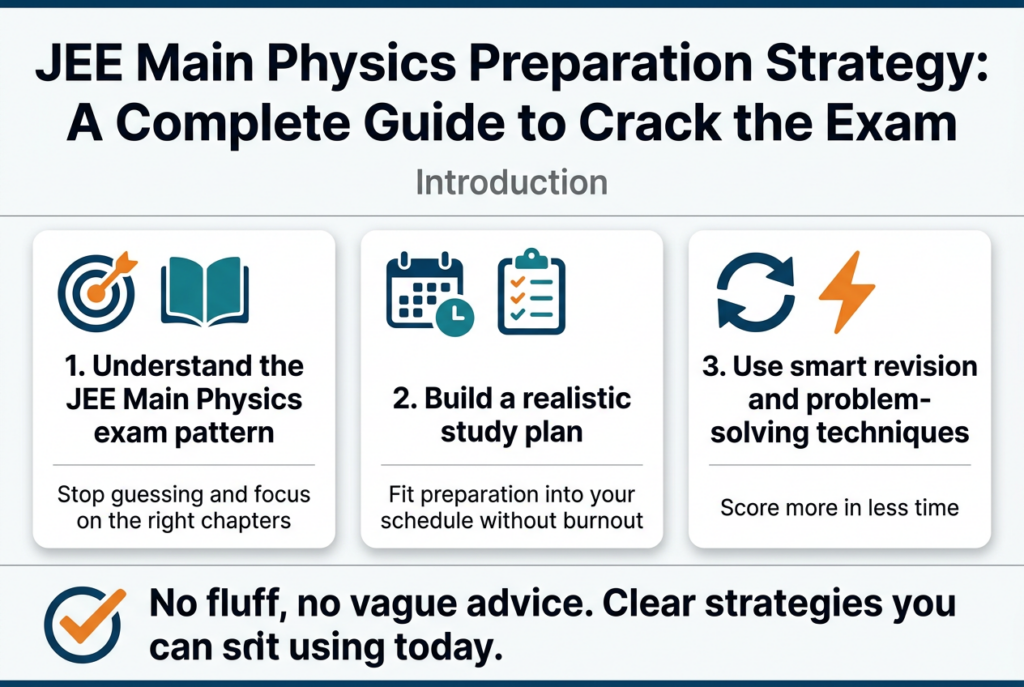
If you’re gearing up for JEE Main 2027 and Physics feels like the toughest wall to climb, you’re not alone. Most students either spend too much time on topics that barely show up or skip the fundamentals and then wonder. There’s a specific kind of frustration that hits JEE aspirants around the 3-month mark. You’ve worked through chapters in HC Verma. You’ve read NCERT cover to cover. You understand Gauss’s Law and can solve standard problems from the books. But when a full mock paper lands in front of you and the clock starts ticking, something breaks down.
That gap — between knowing Physics and performing in Physics — is what most preparation guides never address. A real JEE Main Physics preparation strategy isn’t about chapter lists — it’s about what happens when the clock starts. This guide is built for that.
What follows covers the parts of JEE Main Physics preparation that actually determine your score on exam day: how the paper is really structured, why Integer Type questions are your biggest untapped opportunity, which topics you can safely deprioritize, how to prepare without coaching access, and exactly how to manage 60 minutes of Physics in the exam hall.
Why Most JEE Main Physics Strategies Fail Before Exam Day
Here’s something worth sitting with: Physics contributes 100 out of 300 marks in JEE Main. A single-digit improvement in your Physics percentile — say, going from 85th to 92nd — can shift your overall rank by tens of thousands of positions. The subject has that much leverage.
And yet the average preparation strategy for Physics looks like this:
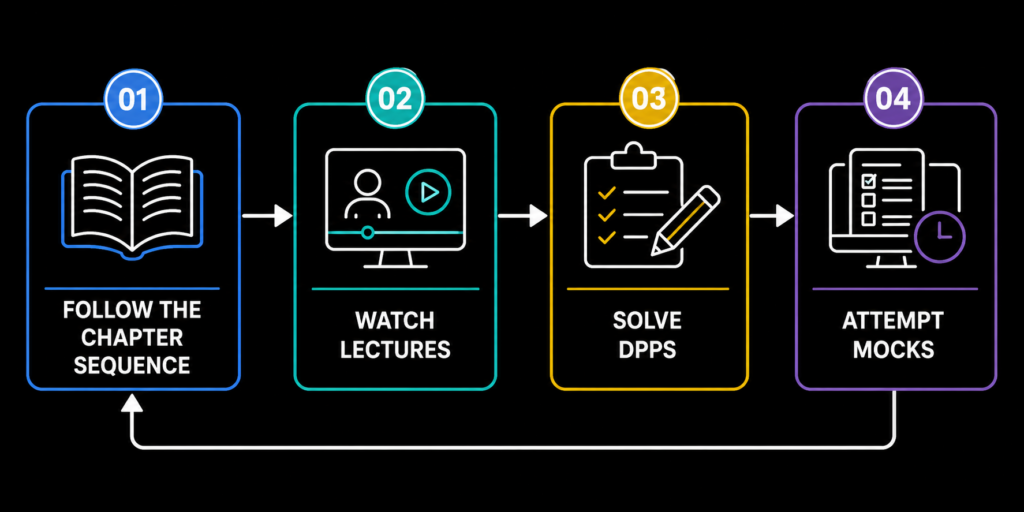
That’s not wrong. But it’s incomplete in a critical way — it prepares you for the subject without preparing you for the exam. It doesn’t address time management inside the paper — how to allocate 60 minutes when the questions are staring at you. And it doesn’t tell you what JEE Main toppers do differently when they sit down in that exam hall.
The exam has specific structural features that reward specific behaviours. Students who know about these features in advance outperform equally prepared students who don’t. This guide is about those features.
The Integer Type Question Strategy Nobody Talks About
Let’s be direct about this: the five Integer Type questions in JEE Main Physics are the most underutilized scoring opportunity in the entire paper.
Here’s why. Because there are no options to eliminate and no guessing shortcut, most students treat these questions as “hard” by default and deprioritize them during preparation. In the exam, they attempt the MCQs, run low on time, and leave two or three Integer Type questions blank. At zero penalty for wrong answers, leaving them blank is almost always the wrong decision.
The reality is that Integer Type questions in JEE Main Physics are not inherently harder than MCQs. They’re just different. The question is usually straightforward once you identify the right concept — the challenge is that you must arrive at an exact number, which means you need to be careful with units, rounding, and setup.
Common traps that cost students marks in Integer Type questions:
Unit mismatches. A question gives you mass in grams and distance in centimetres, then asks for energy in joules. Students who work in CGS units get answers that are off by a factor of 10 or 1000. The fix: at the start of every numerical, convert everything to SI units before doing anything else.
Rounding too early. If a problem has three calculation steps and you round off at each step, your final answer drifts from the correct one. Round only at the end.
Not reading the format instruction. Some Integer Type questions ask you to enter the answer in specific units (“express your answer in mJ” or “give the nearest integer”). Missing this detail means a correct calculation gives a wrong submission.
Chapters where Integer Type questions appear most frequently are Electrostatics, Current Electricity, Mechanics (especially Work-Energy and Rotational Motion), and Modern Physics.
Practical rule: during your preparation, whenever you’re practicing a chapter from PYQs, identify which questions could have been asked as Integer Type and solve them without looking at the options. That habit trains you for exam conditions better than any other approach. You can find chapter-wise JEE Main Physics previous year question papers to practice this with immediately.(link Phyzer.in)
Chapter Priority Map: Concepts to Master, Manage, or Skip

Not all chapters deserve the same preparation time. Before diving in, check the updated JEE Main Physics syllabus to confirm which topics are currently active — NTA revised it in 2023 and some older study materials haven’t caught up. Here’s how to sort what remains.
Tier 1: Master these (target 40–52 marks)
Four chapter groups consistently account for the majority of Physics marks in JEE Main:
Electrostatics and Current Electricity together deliver 3–4 questions per paper, often including one Integer Type. Master Coulomb’s Law, Gauss’s Law applications (especially the infinite sheet and sphere), capacitor combinations, Kirchhoff’s Laws, and the Wheatstone Bridge. For Electrostatics, HC Verma Chapters 29–30 give you exactly the depth JEE Main needs without veering into JEE Advanced territory. The Wheatstone Bridge in particular appears in almost every JEE Main paper in some configuration — if you can solve any Wheatstone Bridge setup in under 90 seconds, you’ve essentially guaranteed yourself 4 marks.
Mechanics — Laws of Motion, Work-Energy-Power, and Rotational Motion — is the largest chapter cluster in JEE Main Physics. For Rotational Motion specifically, NTA loves testing the “rolling without slipping” condition in different surface setups. Get comfortable with moment of inertia for standard bodies (ring, disc, solid sphere, hollow sphere) and with combining translational and rotational kinetic energy.
Modern Physics — Dual Nature of Matter, Atoms, and Nuclei — is formulaic but predictable. Once you know the photoelectric effect equations, de Broglie wavelength formula, Bohr model energy levels (with the hydrogen atom as the standard), and the half-life formula, you can solve most Modern Physics questions in JEE Main. This is a chapter group where consistent formula revision pays off disproportionately.
Optics is the one area where diagrams matter more than formulas. Ray diagrams — concave mirror with object at different positions, convex lens, total internal reflection setup — come up repeatedly. Draw them by hand during preparation, not just mentally. A correct diagram prevents the most common Optics mistake: applying the mirror formula with the wrong sign convention.
Tier 2: Manage these (target 30–35 marks)
Thermodynamics, Kinetic Theory, Electromagnetic Induction, Alternating Current, Kinematics, and Gravitation all deserve solid preparation but are less frequently tested than Tier 1. For these chapters, aim to clear the standard question types without going deep into advanced problems. PYQs are your best guide for what “standard” looks like.
Tier 3: Safe to deprioritize (5–10 marks)
After NTA’s 2023 syllabus revision, Communication Systems was effectively de-emphasized, and several Experimental Skills topics were removed. Many students still spend hours on Communication Systems because older study materials include it — stop. The marks available from this group don’t justify the preparation time relative to what you can gain by strengthening a Tier 1 chapter.
Also within Tier 2 and 3, there are specific sub-topics that are regularly tested in predictable, formulaic ways. Radioactive decay calculations in Modern Physics almost always involve the half-life formula and nothing more. Standard capacitor combinations in Electrostatics (series, parallel, and the mixed type) come up in forms you’ve almost certainly seen before. Targeting these “quick-win” sub-topics in your final weeks gives you reliable marks with minimal new learning.
The Self-Study Path: How to Prepare Without Coaching
Most JEE Main Physics guides are written by coaching institutes. Every tip assumes you have access to daily lectures, DPPs handed to you each morning, a faculty member to ask doubts, and a peer group to benchmark against. That’s not the reality for a large number of serious JEE aspirants.
If you’re preparing without coaching — either fully self-studying or using online resources (You can refer our channel Aakansh Physics Academy) — here’s what actually works.
Your core resource stack: NCERT Physics (both Class 11 and 12) for conceptual foundation, HC Verma’s Concepts of Physics for numerical depth, and NTA’s official previous year question papers (freely available on nta.ac.in) for exam-level practice. That combination covers roughly 85–90% of what JEE Main Physics tests. For a detailed comparison of which books to use at each stage, see our guide to the best books for JEE Main Physics. You don’t need ten books. You need to know three books deeply.
Time management for self-studiers: Without a coaching schedule imposing structure, you need to create your own. If you’re in Class 11 or 12 and preparing alongside board exams, 14–18 hours of dedicated JEE Physics study per week is realistic — roughly 2–2.5 hours on weekdays and 4–5 hours on weekends. Don’t try to study Physics for 6 hours straight; 90-minute focused blocks with a short break outperform marathon sessions by a significant margin.
Exam-Day Time Management: The 60-Minute Physics Plan
The JEE Main paper runs for 3 hours. If you divide it equally, Physics gets 60 minutes. But “dividing equally” is not actually a good strategy — Chemistry tends to be faster for most students, which means you can budget 55–65 minutes for Physics if you’re disciplined about Chemistry.
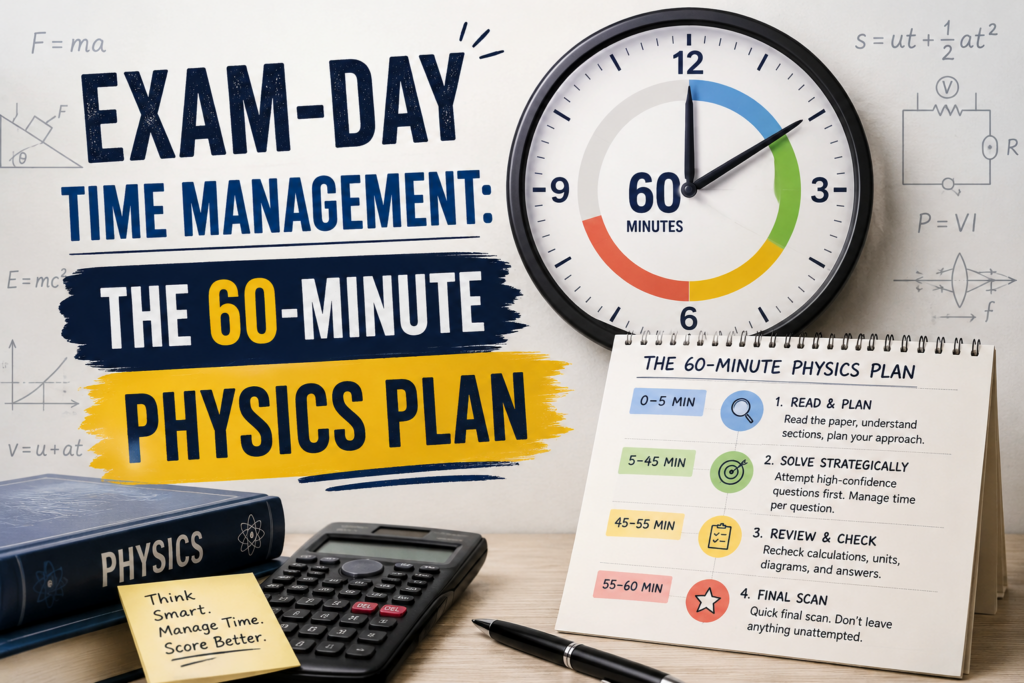
Here’s a question-by-question approach that works:
First pass (30 minutes): Go through all 25 questions in order. Solve every question you can answer in under 2 minutes. Don’t linger — if a question needs more than 2.5 minutes, flag it and move on. At the end of 30 minutes, you should have attempted 14–17 questions and have a clear set of flagged ones to return to.
Second pass (20 minutes): Return to flagged moderate-difficulty questions. These are the ones you knew how to approach but needed more time. Solve them now. Each of these is a realistic 4 marks.
Third pass (10 minutes): This is specifically for Integer Type questions you haven’t attempted yet. With zero negative marking, there is almost no scenario where you should submit your paper with an unattempted Integer Type question. Even if your calculation gives you a number you’re not confident about — submit it. The expected value of attempting is always positive.
One more thing: learn the NTA CBT interface before exam day(Join Aakansh Physics Academy CBT-Test Series). The “Mark for Review and Next” button flags a question without answering it. The “Save and Next” button records your answer. Students who confuse these in exam conditions lose marks they shouldn’t. Practice on the NTA mock test interface at least twice before your actual exam
Phase-Wise JEE Main Physics Preparation Timeline: 12 Months to Final Week
Strategy changes depending on how far you are from the exam. Here’s what to focus on at each stage.
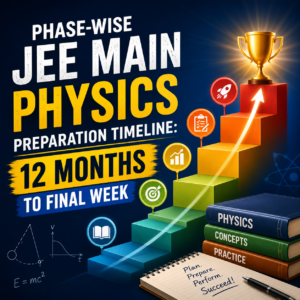
12+ months out (Class 11 students starting early): This phase is about building the right mental model for Physics, not rushing through chapters. Don’t skip derivations. Understanding why F = ma works and when it breaks down (non-inertial frames, for instance) is what separates students who get 65 in Physics from students who get 85. Solve one or two standard problems per concept — not fifty. Depth over breadth at this stage.
6 months out: By now, your first pass through the syllabus should be complete or nearly complete. Shift to chapter-wise PYQ solving. Take a chapter — say, Electromagnetic Induction — and solve all JEE Main PYQs from the last 10 years on that chapter in one sitting. You’ll start seeing patterns. NTA reuses question structures more than most students realize. The numbers change; the setups often don’t.
3 months out: Full-length mocks, weekly. Not chapter tests — full papers. After each mock, spend as long on the analysis as you spent on the exam itself. Where did you drop marks? Was it concepts you hadn’t studied, concepts you’d studied but forgotten, careless errors, or time management? Each of these requires a different fix.
1 month out: No new chapters. Strengthen weak sub-topics you’ve already studied. Your Tier 1 chapters should be on autopilot by now. This is the period where many students panic and try to “complete” something they’ve left out — don’t. The chapters you’ve prepared well will carry you further than a rushed first read of a new chapter.
Final week: Formula sheets and notes only. One light mock, two days before the exam, to keep your timing calibrated — not to cram. Sleep of 7–8 hours per night is not optional at this stage; sleep deprivation measurably reduces reaction time and working memory, both of which you need in an exam that rewards speed and accuracy.
For droppers: The biggest trap in a drop year is re-reading everything from the beginning. You already have conceptual foundation. What you need is targeted repair — identify your specific weak chapters from JEE Main attempt(s), focus there, and spend the majority of your time on PYQs and mocks. Students who use drop years for deliberate practice rather than repetitive re-reading typically see significant score improvements.
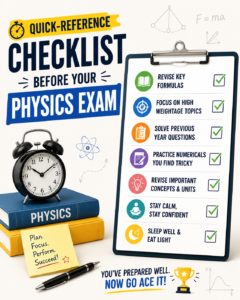
Quick-Reference Checklist Before Your Physics Exam
Use this in the 48 hours before your exam — not to learn new things, but to make sure nothing you already know slips through the cracks.
Formula revision order (prioritize these chapters): Electrostatics (Gauss’s Law, capacitor formulas), Current Electricity (Kirchhoff’s Laws, Ohm’s Law with internal resistance), Rotational Motion (moment of inertia for standard bodies, rolling condition), Modern Physics (photoelectric effect, Bohr model, half-life), Optics (mirror and lens formula with sign convention clearly noted). For rapid formula recall, use the summary boxes at the end of each HC Verma chapter — they’re concise and exam-aligned.
Common mistakes to keep top of mind:
- In Optics: mirror formula and lens formula use the same sign convention but different configurations — draw a quick diagram for every optics problem, don’t solve blindly with formulas
- In Current Electricity: internal resistance of a battery is almost always relevant when a question mentions a “battery” or “cell” — students who ignore it get wrong answers on problems that are otherwise straightforward
- In Modern Physics: the stopping potential question in photoelectric effect trips students who confuse it with kinetic energy — stopping potential equals maximum kinetic energy divided by electron charge (in eV it’s numerically equal to maximum kinetic energy)
- In Mechanics: when in doubt about a system with multiple objects, draw a separate free body diagram for every object before writing any equation
- Mental checklist for every question in the exam:
- Read the full question before setting up anything
- Identify which chapter and concept this is testing
- Write down the given values with units
- Write the applicable formula
- Check units before calculating
- For MCQs, see if your answer matches one of the options — if it doesn’t, something went wrong before the calculation
At the test centre: Reach 30 minutes early to avoid the mental noise of rushing. Some test centres have keyboards/mice that feel different from what you’re used to. Give yourself 5 minutes at the start of the exam to settle, read the instructions, and take two slow breaths before hitting the first question.
Physics is not a subject that rewards students who know the most. It rewards students who perform the most consistently. Every section of this guide — from the Integer Type approach to the 60-minute exam plan — is about building that consistency. That’s what a JEE Main Physics preparation strategy built for the exam hall, not just the study table, actually looks like.
📋 Download the Free JEE Main Physics Pre-Exam Checklist
The 48-hour checklist from this article — formula revision order, common mistake flags, and the exam-day mental routine — in a single printable sheet.
Or take a free JEE Main Physics mock test → (https://aakanshphysicsacademy.com/programs/test-series/) to see exactly where your preparation stands right now.
Frequently Asked Questions
How many hours should I study Physics for JEE Main?
For Class 11 and 12 students balancing board exams, 14–18 hours per week is realistic and sustainable. That’s about 2–2.5 hours on weekdays and 4–5 hours on weekends. Quality matters more than raw hours — a focused 90-minute session with PYQ practice will outperform a distracted 4-hour marathon every time.
Is HC Verma enough for JEE Main Physics?
HC Verma paired with NCERT covers roughly 85–90% of what JEE Main tests. For Mechanics, Electrostatics, and Modern Physics — the three heaviest chapters — HC Verma is more than sufficient. The one area where students sometimes need additional practice is Optics numericals, where DC Pandey’s exercise sets offer more variety. But don’t add books out of anxiety — finish what you have first.
Which chapters are most important for JEE Main Physics?
Electrostatics, Current Electricity, Mechanics (Laws of Motion + Rotational Motion), Modern Physics, and Optics together account for 40–52 marks out of 100. These are your Tier 1 chapters. If your preparation time is limited, securing these chapters thoroughly will get you further than a shallow pass through the entire syllabus.
Should I attempt Integer Type questions if I’m unsure?
Yes — always. Integer Type questions carry zero negative marking, which means the expected value of any attempt is positive. Even an educated guess based on dimensional analysis or order-of-magnitude reasoning is better than leaving them blank. The only scenario where skipping makes sense is if attempting would cost you time that leads to dropping marks on MCQs you know well.
How do I manage time in the JEE Main Physics section?
Use the three-pass system: spend the first 30 minutes on questions you can solve in under 2 minutes, the next 20 minutes on flagged moderate questions, and the final 10 minutes on Integer Type questions. Never leave the exam with unattempted Integer Type questions — revisit them in the final sweep regardless of confidence level.