Read time ~4-5 minutes
The real CBSE Class 12 Physics weightage 2026-27, chapter wise — based on CBSE’s official unit groups, not guesswork. Includes typology breakdown, practical marks, and a study plan by Aakansh Physics Academy- one of the best institutes in Dwarka , New Delhi
CBSE Class 12 Physics Weightage 2026-27- Chapter Wise
Quick answer: CBSE Class 12 Physics is scored out of 100 — 70 for theory, 30 for practical. The 70 theory marks are split across 5 official unit groups:
Electrostatics + Current Electricity (16), Magnetic Effects + EMI/AC (17), EM Waves + Optics (18), Dual Nature + Atoms & Nuclei (12), and Electronic Devices (7). Full breakdown, chapter-level detail, and a study plan below.
Search “class 12 physics weightage chapter wise” and you’ll get four blogs telling you four different things. One says Electrostatics is worth 10 marks. Another says 8. One says Optics is 14, another says 13. They can’t all be right — and honestly, none of them are, because CBSE doesn’t publish a chapter-wise weightage at all.
It publishes a unit-wise weightage, where units are groups of two or three chapters bundled together. Every blog you’ve seen has taken that official grouped number and tried to guess how it splits between the chapters inside the group. That guesswork is exactly why the numbers don’t match from site to site. Once you see the actual CBSE grouping, the confusion makes sense — and more importantly, you stop wasting time reconciling five different tables and just study off the real one.
I’m Aakansh Sir, and at Aakansh Physics Academy, clearing up exactly this confusion is the first thing I do with every Class 12 batch before board season starts. So let’s settle it properly, using CBSE’s own document instead of five conflicting blogs.
The official CBSE weightage table-2026-27
| Unit Group | Chapters Inside | Marks |
| Electrostatics + Current Electricity | Electric Charges & Fields, Electrostatic Potential & Capacitance, Current Electricity | 16 |
| Magnetic Effects + EMI/AC | Moving Charges & Magnetism, Magnetism & Matter, Electromagnetic Induction, Alternating Current | 17 |
| EM Waves + Optics | Electromagnetic Waves, Ray Optics & Optical Instruments, Wave Optics | 18 |
| Dual Nature + Atoms & Nuclei | Dual Nature of Radiation and Matter, Atoms, Nuclei | 12 |
| Electronic Devices | Semiconductor Electronics | 7 |
| Theory Total | 70 | |
| Practical | 30 |
Group by group — what to actually expect

Electrostatics + Current Electricity (16 marks). This is your most numerical-heavy zone. Expect a Kirchhoff’s rules or Wheatstone bridge numerical , a capacitor-combination problem (series-parallel, sometimes with a dielectric slab inserted), and at least one Gauss’s theorem application — the classic “find the field due to an infinite charged sheet” type. Drift velocity and mobility show up almost every year as a 2-mark conceptual question, not a long numerical, so don’t over-invest time there.
Magnetic Effects + EMI/AC (17 marks). Biot-Savart and Ampere’s law questions tend to be derivation-based (deriving the field due to a Current carrying Ring at Axial Point), while the EMI/AC side is where the real numerical live — self and mutual inductance problems, derivation for Mutual Inductance is really important for Board’s point of view, LCR circuit impedance, and transformer step-up/step-down calculations. If you’re going to memorize one derivation cold, make it the moving coil galvanometer conversion to ammeter/voltmeter — it’s a recurring 3-mark ask.
EM Waves + Optics (18 marks) — the single biggest group. EM Waves itself is light: mostly 1-2 mark questions on the electromagnetic spectrum and the qualitative nature of displacement current, nothing numerical. The weight sits almost entirely in Optics — lens maker’s formula, combination of thin lenses, and refraction through a prism for Ray Optics; Young’s double slit fringe-width calculation and the qualitative Huygens’ principle proof of reflection/refraction for Wave Optics. If you only have time to master two numerical in this entire group, make them the lens maker’s formula with sign convention and the YDSE fringe-width problem — they’re the ones that repeat with different numbers every year.
Dual Nature + Atoms & Nuclei (12 marks). Einstein’s photoelectric equation numerical (finding stopping potential or work function) is close to guaranteed. Bohr’s model — radius, velocity, and energy of the electron in the nth orbit — is the other reliable numerical. Binding energy per nucleon and its variation with mass number is usually a graph-based conceptual question rather than a calculation, so know what the curve looks like and why it dips at both ends, more than the formula.
Electronic Devices (7 marks). Semiconductor diode I-V characteristics and the diode-as-rectifier explanation cover most of this. It’s conceptual, low on numerical, and genuinely one of the fastest 7 marks to lock in if you’ve done even two revision passes.
The typology breakdown nobody else mentions
This is the part that actually changes how you should study. CBSE splits the 70 theory marks by cognitive difficulty, not just by topic:
| Question Type | Marks | Share |
| Remembering & Understanding | 27 | 38% |
| Application (numericals, formula-based) | 22 | 32% |
| Analysis, Evaluation & Creating (HOTS, derivations) | 21 | 30% |
Here’s why this matters more than the topic weightage: nearly 40% of your paper is scorable just by knowing definitions, laws, and stated facts correctly — no numerical skill required. That’s Ohm’s law statement, Lenz’s law statement, what a p-n junction is, why EM waves are transverse. Students who obsess over numerical practice while under-revising these “easy” conceptual marks are leaving points on the table that cost almost no time to secure. Balance your revision so the first pass covers every definition and law cold, before you sink hours into numerical drilling.
Practical exam (30 marks) — the part everyone glosses over
| Component | Marks |
| Two experiments (one from each section) | 7 + 7 |
| Practical record | 5 |
| One activity | 3 |
| Investigatory project | 3 |
| Viva | 5 |
The two experiments are 14 of your 30 practical marks — the single biggest chunk — and they come from a fixed list:
- Resistance-per-cm using a V-I graph,
- Verifying series/parallel resistance laws,
- The meter bridge,
- Half-deflection method for galvanometer resistance,
- Identifying components (resistor/capacitor/inductor/diode),
- Distinguishing convex/concave lenses and mirrors, and
- The two transformer/inductor design experiments.
Practice all of them at least once physically, not just read about them — viva questions (Viva Guide booklet by Aakansh Physics Academy) are drawn directly from what you did with your hands, and “I read the theory” answers fall apart under a follow-up question about your own graph.
At Aakansh Physics Academy, we run mock viva sessions before the actual practical exam — it’s the single biggest score-lifter I’ve seen for those 5 viva marks. Students who’ve only rehearsed answers on paper tend to freeze the moment an examiner asks “why did your graph curve there?” instead of “what does Ohm’s law state?”
A study plan based on actual marks, not guesswork– By Aakansh Sir
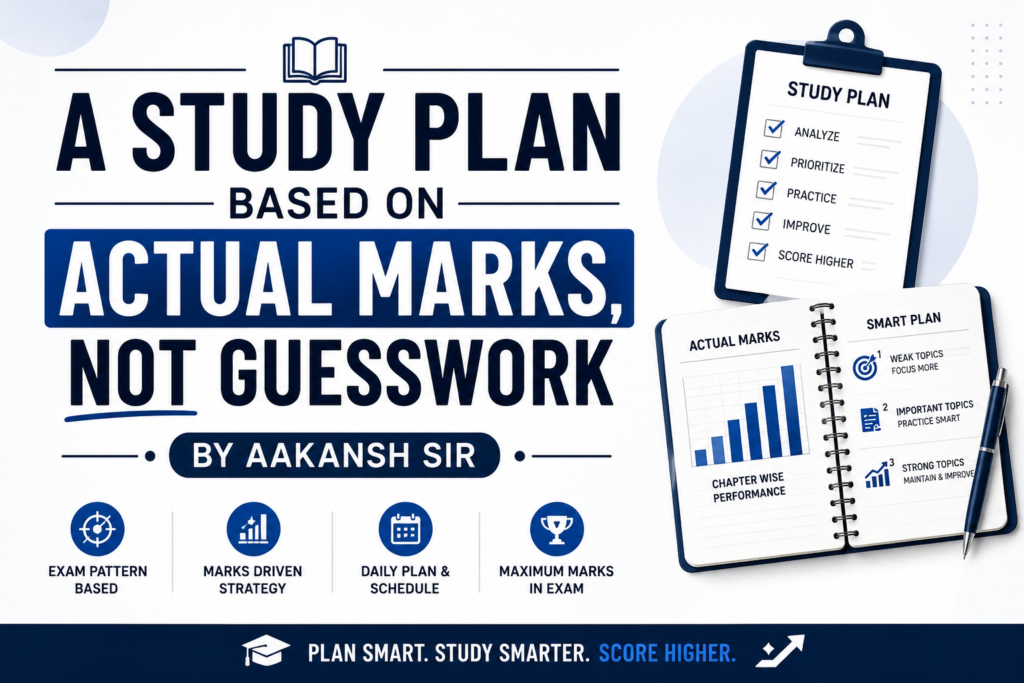
If you’re building a timetable off this, weight your hours roughly to the marks- EM Waves + Optics (18) and Magnetic Effects + EMI/AC (17) should each get noticeably more revision time than Electronic Devices (7) — not because the smaller chapters don’t matter, but because the Return Per Hour (RPH) is lower once you’ve covered the basics.
A practical way to split a 6-week revision runway–
Optics and EMI/AC combined ~ Two Weeks
Electrostatics + Current Electricity ~ One Week
Atoms/Nuclei + Dual Nature ~ One Week
Electronic Devices ~ Half a Week
Magnetic effects ~ Half a Week and
the remaining time on full-length papers and the practical experiment list. Save at least three full 3-hour mock attempts for the final two weeks — timing yourself against the typology split above (spend proportionally less time per mark on the Remembering/Understanding questions so you’re not burning clock time on the “cheap” marks).
This is close to the actual revision sequence we run at Aakansh Physics Academy — students who front-load Optics and EMI/AC, instead of studying strictly in chapter order, consistently walk into the numerical sections of the paper with more confidence.
Want this timetable built out day-by-day for your specific board date? Download our free 6-week revision planner
FAQ’s
Why do different websites show different marks for the same chapter? Because CBSE only publishes grouped unit weightage (like the 16/17/18/12/7 table above), not a chapter-by-chapter number. Every site showing you a fixed per-chapter figure is estimating the internal split themselves.
Which single chapter carries the most weight? No single chapter is scored alone — but within the 18-mark EM Waves + Optics group, Optics (Ray + Wave combined) accounts for the large majority of it, making it the highest-value group to prepare thoroughly.
Is the 2026-27 weightage different from last year? No. CBSE’s April 2026 syllabus release kept the unit-wise weightage identical to 2025-26.
How much of the paper can I score without touching numerical? Roughly 38% (27 marks) falls under Remembering & Understanding — pure conceptual and definitional recall, no calculation needed.
Do I need coaching notes, or is NCERT enough? NCERT covers the full syllabus and almost every numerical pattern CBSE draws from directly. Reference books help for extra practice questions, but skipping NCERT’s own solved examples is the most common reason students misjudge difficulty on numerical during the actual exam.
If you want a chapter-by-chapter revision plan built around this exact weightage — not a generic one — Aakansh Physics Academy runs a dedicated board crash-course batch for Class 12 Physics every year. See the batch schedule →
Still Finding Physics Difficult?
Don’t let Physics affect your Board percentage or competitive exam rank.
Join Aakansh Physics Academy-one the Best institutes in Dwarka, New Delhi , where hundreds of students have improved their understanding through:
- Concept-first teaching
- Complete derivation practice
- Previous year question analysis
- Board answer-writing techniques
- Regular tests with performance tracking
- One-to-one doubt support
Online & Offline Classes | JEE | NEET | CBSE
📍 Dwarka, New Delhi | 🌐 www.aakanshphysicsacademy.com
📞 Book a free counselling session today and experience the Aakansh Physics Academy difference.
About the author: Aakansh Sir-One of the Best Physics Teacher of Dwarka- has been teaching JEE and Advance /NEET / CBSE Class 12 Physics for 12 years at Aakansh Physics Academy, Dwarka, New Delhi, where he is specialized Physics and is in exam strategy and weightage-based revision planning. Learn more about Aakansh Physics Academy → www.aakanshphysicsacademy.com