Reading time : 6~7 minutes
If you’re looking for the important derivations for 12th CBSE physics, every top-ranking page gives you a list of names with no context on what actually matters for your exam — no marks weightage, no common mistakes, nothing that tells you where to focus with limited time. Aakansh Physics Academy is providing you the opposite: a fast, no-fluff scan of every important derivation, what it’s really testing, and where marks tend to slip.
Whether you’re a student revising the night before boards, a parent trying to help without a physics background, or a teacher planning a revision session, this list is built to be scanned in one sitting and referenced again closer to exam day.
Why Derivations Matter More Than Their Marks Suggest
According to Aakansh Sir “CBSE uses stepwise marking on derivations — you can lose marks for a missing diagram, an unclearly labelled angle, or an unstated assumption, even when your final formula is correct. A 3-mark derivation typically splits into a mark for the diagram/setup, a mark for correctly applying the relevant law, and a mark for the final expression. Miss any one of these, and the mark goes with it, regardless of how right your final answer looks.”
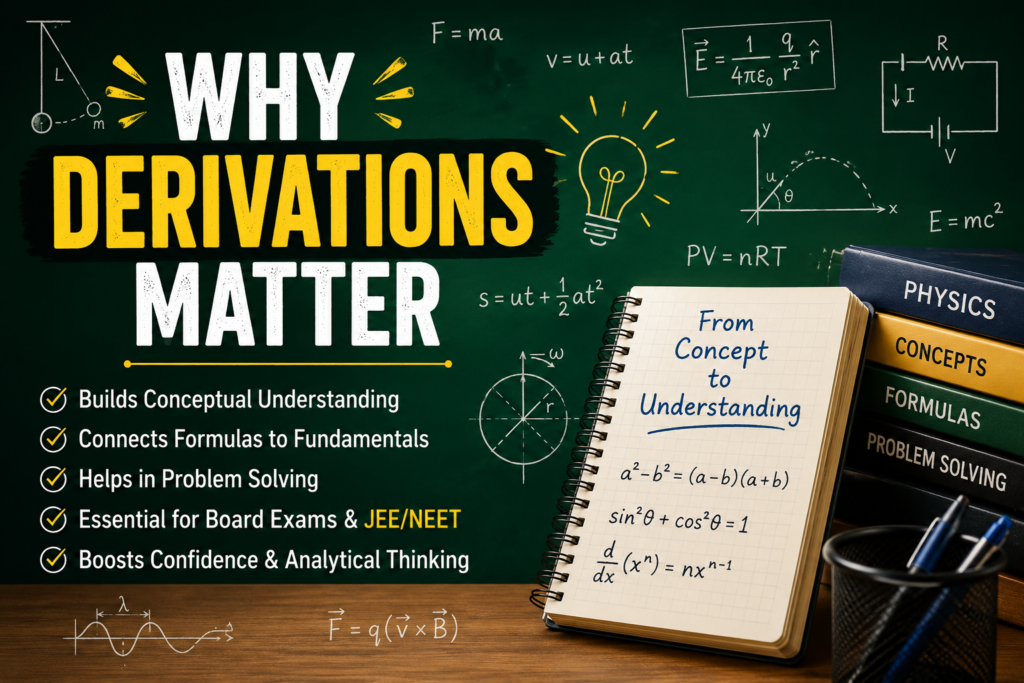
Derivations also feed directly into numerical later in the same paper. A question might ask you to find the electric field near a dipole at some specific distance — but if the geometry is slightly different from the standard axial or equatorial case, you need to understand the logic of the derivation, not just recall its final line, to adjust correctly. This is exactly why these derivations for 12th CBSE keep showing up, in some form, year after year — they’re not just standalone questions, they’re the foundation the rest of the paper is built on.
For the official topic list, cross-check against the CBSE Class 12 Physics syllabus — question papers are set strictly against it each year.
Quick Reference-Weightage Table
According to Aakansh Physics Academy, here’s the full list of important derivations for 12th CBSE Physics, ranked by how often they’ve appeared in board papers over the last decade:
| Chapter | Derivation | Marks | Frequency (last 10 yrs) |
| Electrostatics | Dipole field (axial/equatorial) | 3 | High |
| Electrostatics | Torque on dipole | 2 | Medium |
| Electrostatics | Gauss’s law — Wire/sheet/sphere | 3 | Very High |
| Electrostatics | Capacitor with dielectric | 3 | High |
| Current Electricity | Drift velocity & current | 2 | Medium |
| Current Electricity | Wheatstone bridge | 3 | High |
| Current Electricity | Cells connected in series and Parallel | 3 | Medium |
| Magnetism/EMI | Biot-Savart — loop centre | 3 | Very High |
| Magnetism/EMI | Biot-Savart — Axial point | 3 | Very High |
| Magnetism/EMI | Moving coil Galvanometer | 5 | Very High |
| Magnetism/EMI | Torque on current loop | 3 | High |
| Magnetism/EMI | Motional EMF | 3 | High |
| Magnetism/EMI | Mutual Inductance | 3 | High |
| EMI/AC fundamentals | AC generators | 5 | High |
| AC fundamentals | Transformer | 5 | High |
| Optics | Mirror formula | 3 | Very High |
| Optics | Lens maker’s formula | 3 | High |
| Optics | Prism — minimum deviation | 3 | High |
| Dual Nature/Atoms | Photoelectric equation | 2 | Medium |
| Dual Nature/Atoms | Bohr model (Radius & Energy) | 5 | Very High |
| Nuclei | Radius of atom | 2 | Medium |
| Semiconductor | Rectifier | 3-5 | High |
(Curious how these numbers were pulled together? Check Previous Year Question Papers — Class 12 Physics)
If you’re short on time, then according to our Physics expert Aakansh sir , Prioritize in this order:
Gauss’s law → Mirror/lens formula → BIOT-Savart → Drift velocity →Bohr model → Wheatstone bridge →Transformer→ Rectifier → the rest.
What Each Derivation Is Actually Testing – A brief analysis by Aakansh Physics Academy
Dipole field (axial): Tests whether you can drop the a² term once r >> a — the single most-skipped assumption in this derivation. Final result: E = 2kp/r³. Examiners often ask why the approximation is valid, not just for the final formula.
Torque on a dipole: τ = pE sinθ. Common trap — writing τ = pE and forgetting the sinθ term, which examiners specifically probe by asking for torque at θ = 90°, where it’s maximum, or at θ = 0°, where it’s zero.
Gauss’s law (infinite sheet): E = σ/2ε₀, independent of distance from the sheet. The exam favorite follow-up question is why it’s distance-independent — the answer is the sheet’s infinite, uniform symmetry, not a general property of charge itself.
Capacitor with dielectric: C=Kε₀A/d. Set K = 1 to recover the vacuum-case formula — mentioning this in your answer signals you understand the dielectric’s role rather than having memorized two separate formulas.
Drift velocity: I = neAvd, with vd = eEτ/m. This is the microscopic explanation for why Ohm’s law holds at all — a good line to add if the question asks you to justify V = IR, not just state it. Don’t confuse drift velocity (mm/s) with electrons’ actual thermal speed (km/s), a frequent objective-question trap paired with this topic.
Wheatstone bridge: P/Q = R/S. The whole derivation hinges on explicitly stating “zero galvanometer current means B and D are at the same potential” — skip that line and you lose a mark even with the correct final ratio.
Biot-Savart (loop centre): B = μ₀I/2R. Works cleanly because every current element is equidistant from the centre and perpendicular to the radius vector (sinθ = 1) — state this symmetry explicitly rather than assuming it’s obvious.
Torque on current loop: τ = NBIA sinθ. This is the working principle of a moving coil galvanometer, and questions sometimes frame the derivation in exactly that context — worth linking the math back to the instrument in your answer.
Motional EMF: ε = Blv. Comes directly from the force on free charges in a moving conductor (F = qvB) — a useful line to mention since it connects this topic back to basic electromagnetic force rather than treating it as a standalone formula.
Mirror formula: 1/v + 1/u = 1/f. Sign convention errors here are the #1 mark-loser across all of optics — state your sign convention clearly before plugging in numbers in the follow-up numerical.
Lens maker’s formula: 1/f = (n−1)(1/R₁ − 1/R₂). Comes from applying single-surface refraction twice (once at each face of the lens) and cancelling the intermediate image term — a structural insight worth mentioning even in a shortened answer.
Prism (minimum deviation): n = sin[(A+δmin)/2] / sin(A/2). Valid only at the specific condition of minimum deviation, where i₁ = i₂ — don’t apply this symmetry assumption to a general prism question where it doesn’t hold.
Photoelectric equation: hν = φ + KEmax. Explains three things classical wave theory couldn’t: instantaneous emission, KE depending on frequency rather than intensity, and a sharp threshold frequency below which no emission occurs at all.
Bohr model: r = 0.529 n²/Z Å, and E = −13.6 Z²/n² eV. The negative energy sign reflects that the electron is bound to the nucleus — examiners occasionally ask you to explain this sign explicitly, so it’s worth having a one-line explanation ready.
Common Mistakes That Cost Marks

According to Aakansh sir here are some common mistakes that cost marks to student and they must keep these in mind while entering the exam hall.
- Sign convention errors, especially in optics and electrostatics
- Skipping the “assume/let” line before an approximation or integration step
- Diagrams missing labelled angles, vectors, or key points
- Jumping from setup straight to the final answer without showing intermediate algebra
- Applying a special-case condition (like prism minimum deviation) to a general question where it doesn’t apply
How to Revise Fast, By Role–
Students: Write each derivation from a blank page with only the diagram given, then check your steps against your notes. Whatever step trips you up twice in a row — that’s your flashcard, not the whole derivation.
Parents: You don’t need a physics background to help meaningfully. Ask your child to explain each step out loud, in plain words, as if explaining it to you. If they can’t say why a step comes next, they’ve memorized it, not understood it — and that’s exactly where they’ll freeze under exam pressure.
Teachers: Spend a minute on the conceptual reasoning (for example, why zero galvanometer current implies equal potential at two points) before writing any equations. Students who grasp this reasoning step rarely make the sign or setup errors that tend to follow later in the derivation.
FAQs
How many derivations are there in Class 12 Physics? Around 18–22 core ones, depending on how sub-cases (like axial vs. equatorial dipole fields) are counted separately.
Are derivations asked every year in CBSE boards? Yes — typically 3–4 derivation-based questions worth a combined 9–12 marks, drawn mostly from the higher-frequency entries in the table above.
Which derivation is most important for Class 12 Physics? Gauss’s law applications and the Bohr model derivation are the two safest, highest-frequency bets based on the last decade of papers.
Can numerical come directly from derivations? Often, yes — sometimes with a slightly modified geometry or condition, which is why understanding the logic behind each derivation matters more than memorizing its final line.
Keep This Handy
Studying solo? Download the one-page PDF version of this list to keep on your phone for last-minute revision.
Teaching a class or helping your child revise? Share this page before your next revision session — it’s built to be skimmed in under seven minutes.
Still Finding Physics Difficult?
Don’t let Physics affect your Board percentage or competitive exam rank.
Join Aakansh Physics Academy, where hundreds of students have improved their understanding through:
- Concept-first teaching
- Complete derivation practice
- Previous year question analysis
- Board answer-writing techniques
- Regular tests with performance tracking
- One-to-one doubt support
Online & Offline Classes | CBSE | JEE | NEET
📍 Dwarka, New Delhi | 🌐 www.aakanshphysicsacademy.com
📞 Book a free counselling session today and experience the Aakansh Physics Academy difference.
Read More Blogs of Aakansh Physics Academy :
- Best Books for JEE Main 2027-Complete Subject-Wise List by Aakansh Physics AcademyBy Aakansh Sir — Physics faculty and founder, Aakansh Physics Academy. Confused about JEE Main 2027 books? Get a subject-wise, expert-checked list of the best Physics, Chemistry & Maths books… Read more: Best Books for JEE Main 2027-Complete Subject-Wise List by Aakansh Physics Academy
- JEE Main 2027 Admit Card Download – Direct Link, Dates & Steps-By Aakansh Physics AcademyJEE Main 2027 admit card download link, release dates for Session 1 & 2, step-by-step guide, and a free last-week prep checklist by Aakansh Physics Academy. JEE Main 2027 Admit… Read more: JEE Main 2027 Admit Card Download – Direct Link, Dates & Steps-By Aakansh Physics Academy
- JEE Main 2027 Online Form Registration Date, Application Process & Fees by Aakansh Physics AcademyJEE Main 2027 online form release date (expected Oct–Nov 2026), step-by-step application process, fees, documents & correction window. By Aakansh Physics Academy JEE Main 2027 Registration Link As per the… Read more: JEE Main 2027 Online Form Registration Date, Application Process & Fees by Aakansh Physics Academy
- CBSE Class 12 Physics Weightage 2026-27-Chapter Wise by Aakansh Physics AcademyRead time ~4-5 minutes The real CBSE Class 12 Physics weightage 2026-27, chapter wise — based on CBSE’s official unit groups, not guesswork. Includes typology breakdown, practical marks, and a… Read more: CBSE Class 12 Physics Weightage 2026-27-Chapter Wise by Aakansh Physics Academy
- Important Derivations for 12th CBSE Physics 2026- The Complete Quick-Revision List by Aakansh Physics AcademyReading time : 6~7 minutes If you’re looking for the important derivations for 12th CBSE physics, every top-ranking page gives you a list of names with no context on what… Read more: Important Derivations for 12th CBSE Physics 2026- The Complete Quick-Revision List by Aakansh Physics Academy