By Aakansh Sir — Physics faculty and founder, Aakansh Physics Academy.
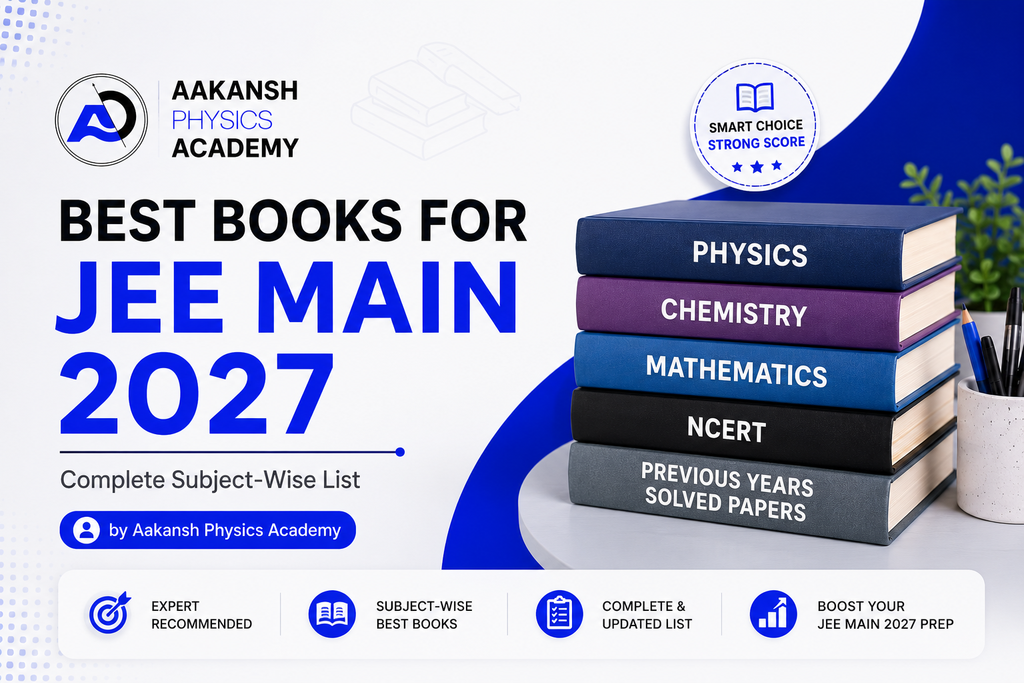
Confused about JEE Main 2027 books? Get a subject-wise, expert-checked list of the best Physics, Chemistry & Maths books — plus what to skip and why.
I’ve taught JEE Physics for over a decade and worked with thousands of students preparing for JEE Main, so this list isn’t pulled from a generic “top books” template — it’s what I’ve actually seen work, and just as importantly, what doesn’t.
If you’re preparing for JEE Main 2027, you’ve probably already realized the hard part isn’t finding books — it’s finding the right ones without drowning in fifteen recommendations that all contradict each other. Every senior, every YouTube video, every coaching WhatsApp group has an opinion. Most of them aren’t wrong, exactly. They’re just not curated for where you actually are right now.
This list is. It’s built subject by subject, backed by what I’ve seen work with real students year after year, and it includes a few honest calls — like which “must-have” books you can actually skip — that most blogs won’t make because it’s easier to just list everything.
Why Your Book Choice Actually Matters
JEE Main isn’t really testing how much you’ve read. It’s testing whether you can solve correctly, and fast, under pressure. That distinction matters more than most students realize when they’re standing in a bookstore trying to decide between five different Physics books.
The wrong books do one of two things: they either drown you in theory you don’t need for this specific exam, or they leave real gaps in exactly the areas JEE Main leans on hardest. Neither helps your rank.
Before we get into the list — always double check the latest JEE Main 2027 syllabus and exam pattern directly on the NTA’s site, since session dates and minor pattern tweaks do shift year to year, and no blog post is a substitute for the official notification.
One more thing, especially for parents reading this alongside your child: this isn’t going to be a 40-book mega list. Book overload is one of the most common ways students quietly sabotage their own prep — more books doesn’t mean more marks, it usually just means less time actually solving problems.
Should You Start With NCERT or Reference Books?
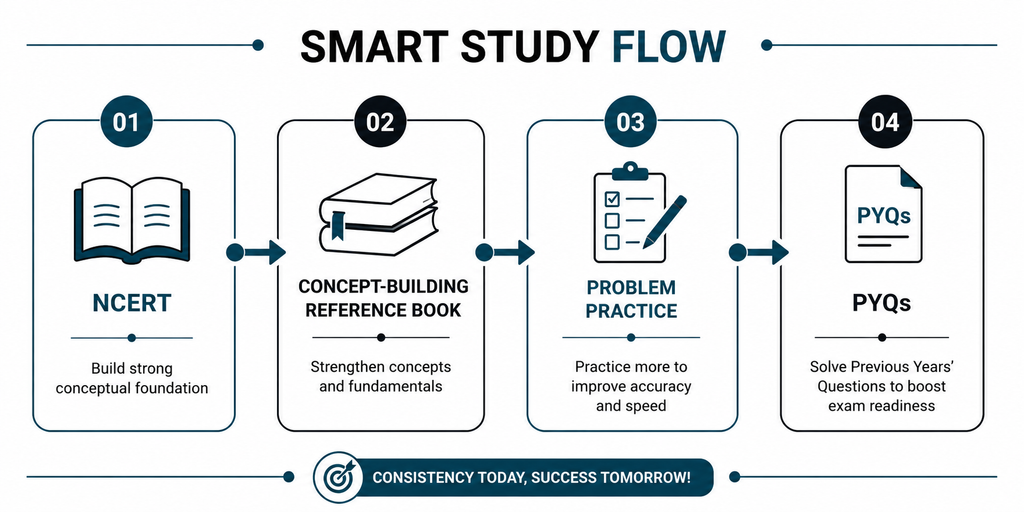
Start with NCERT. Always. This isn’t a soft suggestion — it’s the actual source for a huge chunk of Chemistry (roughly 60-70%) and the conceptual backbone for Physics and Maths too. Skip it, and you’re building reference-book knowledge on a foundation that isn’t there yet.
The sequence that actually works:
NCERT → Concept-building reference book → Problem Practice → PYQs.
In that order, not scrambled.
If you’re in 11th grade, you’ve probably asked this already: do I really need reference books this early, or can that wait? Honestly — not yet, not fully. Focus on getting NCERT rock-solid first. Reference books make far more sense once you’ve got the base concepts down and are ready to build speed and problem variety on top of them.
| Books | What it’s for |
| NCERT | Core concepts, definitions, the actual source of most Chemistry questions and a large share of Physics/Maths logic |
| Reference books | Building problem-solving speed, exposure to varied question types, filling depth gaps NCERT doesn’t cover |
Best Physics Books for JEE Main 2027
- HC Verma — Concepts of Physics, Vol 1 & 2: Still the gold standard for building real conceptual understanding, especially mechanics and optics. If you only trust one book to build actual intuition, this is it.
- DC Pandey — Understanding Physics series: Better if you want a topic-by-topic, step-by-step build rather than jumping straight into harder problems. Good for students who need structure more than speed, at least initially.
- Cengage / BM Sharma: Once the basics are solid, this is where you go for more problem variety and to sharpen speed under time pressure.
A word of honesty most lists avoid: books like Irodov or Halliday-Resnick-Walker get recommended constantly, but they’re genuinely advanced. In my years of teaching JEE Physics, the students who struggle most with mechanics aren’t the ones who skip Irodov — they’re the ones who skip HC Verma’s solved examples and jump straight into harder problems before the fundamentals are automatic. If your basics are still shaky, these advanced books will cost you time you don’t have. Save them for later, if at all.
Best Chemistry Books for JEE Main 2027 (Physical, Organic, Inorganic)
Chemistry splits cleanly into three branches, and honestly, your book choice should too.
Physical Chemistry: P. Bahadur for numerical, alongside NCERT and whatever practice sheets your coaching institute provides.
Organic Chemistry: MS Chauhan for problems, OP Tandon for explanation, and select chapters of Morrison & Boyd if you want deeper mechanism-level understanding.
Inorganic Chemistry: NCERT is the primary source here — not a starting point, the source. JD Lee is useful only for selective deep dives on specific topics, not as a cover-to-cover read.
Worth saying plainly: Inorganic Chemistry is mostly memory work, not conceptual problem-solving. So the real fix isn’t another textbook — it’s building tight revision sheets and going over them constantly, right up until exam day.
Best Mathematics Books for JEE Main 2027
- RD Sharma (Objective): Solid foundation-building, especially if you’re starting from a shaky base.
- Cengage Maths (G. Tewani): Best used to specifically target weak chapters, not as your first read on a topic.
- ML Khanna: Strong for problem variety in algebra and calculus.
One thing worth internalizing early: JEE Main Maths tends to be longer and more calculation-heavy than JEE Advanced-style problems. The exam is really testing speed under pressure, not depth of theory. That means timed practice matters more here than another round of reading formulas.
Best PYQ Books for JEE Main 2027
This is where a lot of students get stuck, and where most blog posts give surprisingly thin advice — probably because it genuinely depends on how you like to study.
The major compilations worth knowing: MTG’s 25 Years(Best for topic-wise practice), Arihant’s 41-43 Years Chapter-wise, Disha’s 42 Years, and the NTA’s own official PYQs. Chapter-wise compilations are better when you’re targeting a specific weak topic. Year-wise, full-length papers are better once you’re closer to the exam and want to simulate real exam conditions and timing.
If you prefer solving offline, all of these are readily available in print on Amazon and Flipkart — worth checking recent reviews before buying, since solution accuracy varies a bit between editions.
A concrete target: solve at least the last 10-15 years, chapter-wise first, then shift to full-length timed papers as the exam gets closer.
Institute Material vs Market Books — What Should You Actually Use?
I get asked this constantly, so let me answer it honestly rather than dodge it.
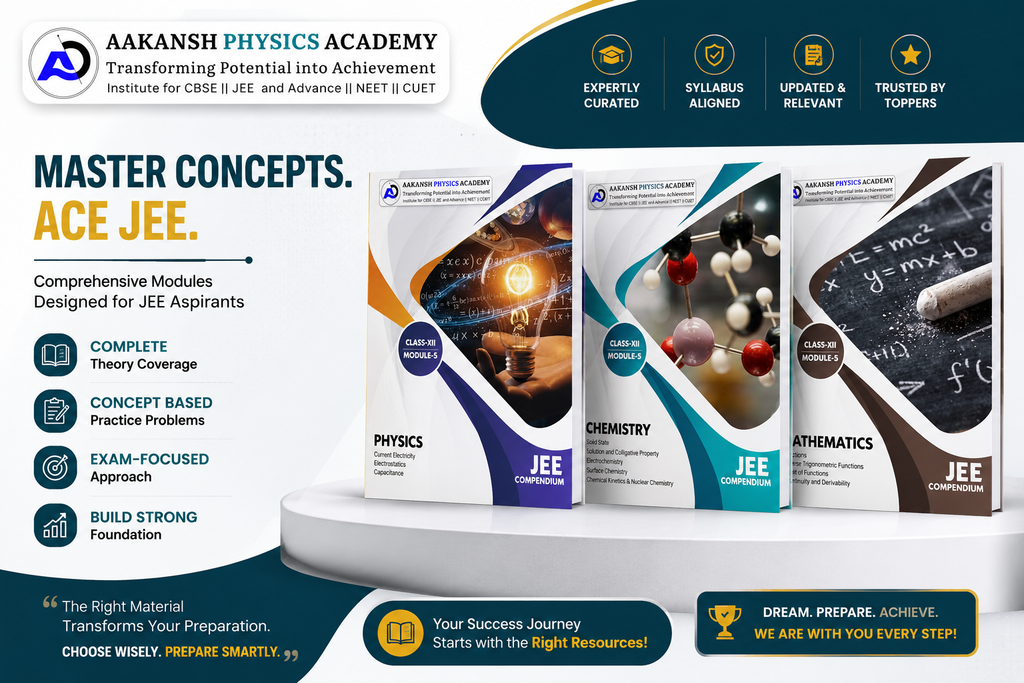
Good coaching material — including what we’ve built at Aakansh Physics Academy — tends to win on a few specific things: it’s mapped directly to the current JEE pattern rather than general Physics/Chemistry/Maths knowledge, it’s faculty-curated around the questions that actually show up, and it’s built for fast revision since it’s already condensed instead of spread across a 600-page textbook.
Key features of our material:
- Concise Theory — Quick-reference notes covering only what’s exam-relevant
- Topic-wise DPPs — Basic-thinking problems + Critical-thinking problems
- Topic-wise Practice Sets — JEE Main and JEE Advanced level problems
- JEE Main PYQs
- JEE Advanced PYQs — Curated by topic and difficulty
It is designed in such a way that it goes from very basic level problems to very advanced level problems step by step to ensure proper understanding of concept
Where standard market books still win: deeper conceptual explanation for students who want to really understand why, broader problem variety, and the fact that they work as standalone resources even without a teacher guiding you through them.
| Criteria | Institute Material | HC Verma / DC Pandey |
| Concept depth | Good, pattern-focused | Excellent, more exhaustive |
| Practice volume | Curated, high-relevance | Larger, more varied |
| JEE-pattern alignment | Very high | Moderate to high |
| Revision speed | Fast (condensed) | Slower (needs filtering) |
| Cost | Included in course | Separate purchase |
I’ve spent years comparing our own Physics material against HC Verma and DC Pandey while designing our curriculum, and honestly, the answer isn’t “pick one.” Most of our strongest students use both — our material for pattern-focused revision, and a standard reference book for the deeper conceptual grounding. Neither replaces the other.
If you want to see exactly what our Physics material covers, you can download a free sample chapter here.
If You Can Only Buy 3 Books — The Minimalist JEE Main 2027 List
If the lists above feel like too much, here’s the short version — one book per subject, no debate:
- Physics: HC Verma
- Chemistry: NCERT (seriously — treat it as your primary Chemistry book, not a supplement)
- Maths: RD Sharma (Objective)
Add a PYQ compilation once you’re comfortable with these three, and you have a genuinely complete setup.
Chapter-to-Book Mapping (Physics & Chemistry)
Some chapters are better served by one specific book over another. A quick reference for the high-weightage ones:
| Chapter | Best Book |
| Rotational Mechanics | HC Verma |
| Electrochemistry | NCERT + P Bahadur |
| Thermodynamics (Physics) | HC Verma + DC Pandey |
| Organic Reaction Mechanisms | MS Chauhan |
| Chemical Bonding | NCERT |
| Coordination Compounds | NCERT + JD Lee (selective) |
| Calculus (Limits, Continuity) | Cengage (G. Tewani) |
| Optics | HC Verma |
| Electrochemistry (Physical) | P Bahadur |
| Coordinate Geometry | ML Khanna |
A few habits that genuinely move the needle: keep an error notebook for every mistake you make (not just the ones that feel important), revise formulas weekly instead of cramming them once, and take a mock test every 7-10 days so exam pressure stops feeling unfamiliar.
And the one rule worth repeating because it’s simply true: one book solved three times beats three books solved once.
Common Mistakes Students and Parents Make
- Buying too many books “just in case”
- Skipping NCERT to jump straight into advanced books
- Putting off PYQ practice until the last month before the exam
- Choosing books based on brand recognition rather than where the student actually is right now
FAQs
Is NCERT enough for JEE Main 2027? For Chemistry, it gets you most of the way there. For Physics and Maths, NCERT builds the foundation, but you’ll need reference books and PYQ practice for the problem-solving speed the exam demands.
How many books should I actually buy for JEE Main? Fewer than you think. One solid book per subject, used properly and revised multiple times, beats a shelf full of half-finished ones.
Which PYQ book is better — Arihant or Disha? Both are reliable. Arihant tends to be slightly more detailed in its solutions; Disha is a bit more compact. Pick based on whether you prefer chapter-wise depth or year-wise simulation, not brand loyalty.
Is coaching or institute material actually better than market books? It depends on what you need it for. Institute material is usually faster to revise from and tightly mapped to the exam pattern. Market books offer deeper, more exhaustive concept-building. Most strong students end up using both.
Can a dropper use the same book list as a first-time aspirant? Yes, with one adjustment — droppers should spend proportionally more time on PYQs and mock tests since the conceptual base is usually already there from the first attempt.
Not sure where to start with your own prep?
Book lists only get you so far — the right starting point depends on where you actually stand right now, not a generic list on the internet. If you’d like a second opinion, book a free one-on-one counselling session with Aakansh Sir and we’ll map out a book and study plan specific to your level.
Prefer to explore on your own first? Download a free sample chapter from Aakansh Physics Academy’s JEE Main Physics material and see how it compares to what’s on this list.
Aakansh Physics Academy has helped thousands of students prepare for JEE Main with a focus on pattern-mapped material and personal mentorship. See our students’ results here.
Read more blogs of Aakansh Physics Academy :
- Best Books for JEE Main 2027-Complete Subject-Wise List by Aakansh Physics AcademyBy Aakansh Sir — Physics faculty and founder, Aakansh Physics Academy. Confused about JEE Main 2027 books? Get a subject-wise, expert-checked list of the best Physics, Chemistry & Maths books… Read more: Best Books for JEE Main 2027-Complete Subject-Wise List by Aakansh Physics Academy
- JEE Main 2027 Admit Card Download – Direct Link, Dates & Steps-By Aakansh Physics AcademyJEE Main 2027 admit card download link, release dates for Session 1 & 2, step-by-step guide, and a free last-week prep checklist by Aakansh Physics Academy. JEE Main 2027 Admit… Read more: JEE Main 2027 Admit Card Download – Direct Link, Dates & Steps-By Aakansh Physics Academy
- JEE Main 2027 Online Form Registration Date, Application Process & Fees by Aakansh Physics AcademyJEE Main 2027 online form release date (expected Oct–Nov 2026), step-by-step application process, fees, documents & correction window. By Aakansh Physics Academy JEE Main 2027 Registration Link As per the… Read more: JEE Main 2027 Online Form Registration Date, Application Process & Fees by Aakansh Physics Academy
- CBSE Class 12 Physics Weightage 2026-27-Chapter Wise by Aakansh Physics AcademyRead time ~4-5 minutes The real CBSE Class 12 Physics weightage 2026-27, chapter wise — based on CBSE’s official unit groups, not guesswork. Includes typology breakdown, practical marks, and a… Read more: CBSE Class 12 Physics Weightage 2026-27-Chapter Wise by Aakansh Physics Academy
- Important Derivations for 12th CBSE Physics 2026- The Complete Quick-Revision List by Aakansh Physics AcademyReading time : 6~7 minutes If you’re looking for the important derivations for 12th CBSE physics, every top-ranking page gives you a list of names with no context on what… Read more: Important Derivations for 12th CBSE Physics 2026- The Complete Quick-Revision List by Aakansh Physics Academy
To know more , you can follow us on :
About the author:
Aakansh Sir-One of the Best Physics Teacher of Dwarka- has been teaching JEE and Advance /NEET / CBSE Class 12 Physics for 12 years at Aakansh Physics Academy, Dwarka, New Delhi, where he is specialized Physics and is in exam strategy and weightage-based revision planning. Learn more about Aakansh Physics Academy → www.aakanshphysicsacademy.com